What's The Difference Between SEO, GEO and AEO?
By Gina Paladini on
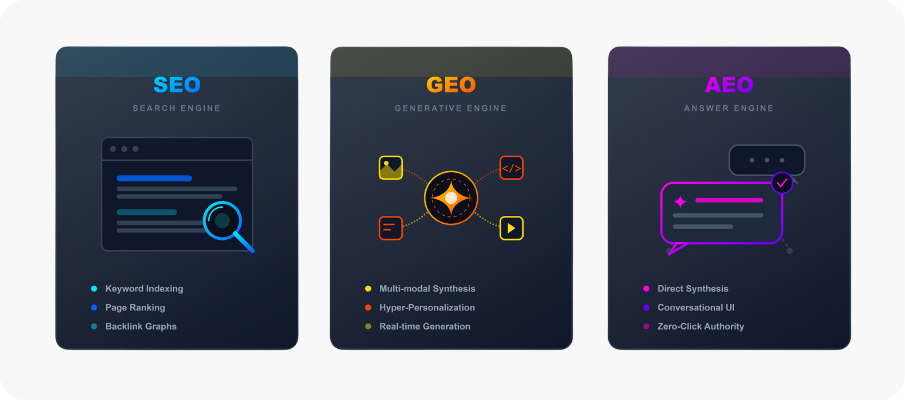
If you've been keeping half an eye on the marketing world lately, you've probably noticed a new alphabet soup floating around: AEO, GEO, and good old SEO.
For years, SEO was the only acronym tourism operators needed to know, now suddenly there are two more letters-based terms getting thrown into the mix, and understandably, a lot of our clients are asking us the same question: "Aren't these all just...the same thing?"
Not quite. And with the way people are searching for (and booking) their next adventure changing fast, it's worth understanding the difference before your competitors get there first.
Let's break it down.
First, a Quick Refresher: What is SEO?
Search Engine Optimisation (SEO) is the practice you already know and love (or possibly love to hate). It's the work that goes into making sure your website ranks well in traditional search engine results, mostly on Google, when someone searches for something like "guided kayak tours Abel Tasman" or "family accommodation Rotorua."
SEO is built around things like:
- Keywords and content relevance
- Site structure and page speed
- Backlinks and domain authority
- Meta titles, descriptions, and alt text
The goal is simple: show up on page one, get the click, get the booking.
So What's GEO?
GEO stands for Generative Engine Optimisation. This is the practice of optimising your content so that it gets picked up, understood, and referenced by generative AI tools like ChatGPT, Google's AI Overviews, Perplexity, and Gemini.
Here's the key difference: traditional search sends people to your website. Generative AI tools often skip that step entirely. Instead of returning a list of links, they generate an answer directly, often pulling together information from several sources (yours hopefully being one of them) and presenting it as one tidy response.
If SEO gets you the click, GEO gets you the mention.
For a tourism business, this might mean an AI tool recommending your walking tour when a traveller asks "what's a good half-day activity in Queenstown for families," without the user ever landing on your website first. Being cited by name inside that answer is the whole game.
To do well here, your content needs to be clear, well-structured, factually accurate, and easy for AI models to extract and summarise, think concise answers, solid use of headings, and information that's genuinely useful rather than vague marketing fluff.
In a nutshell, GEO looks like this:
- Goal: Be cited as a trusted source
- Format: In-depth, authoritative, data-rich content that AI tools can pull from and reference
- Where it happens: ChatGPT, Claude, Gemini, Perplexity, Copilot and similar platforms
- Success looks like: Brand mentions, citations, and (when you're lucky) referral traffic from an AI platform
And AEO?
AEO stands for Answer Engine Optimisation, and it's closely related to GEO (some in the industry use the two terms almost interchangeably, though we'd argue there's a subtle difference).
AEO is about optimising content specifically to appear as the answer on any platform that delivers direct answers rather than a list of links. This includes voice assistants like Siri and Alexa, Google's featured snippets and "People Also Ask" boxes, and increasingly, AI chat tools too.
Think of AEO as answering the exact question a traveller is asking, in the exact format an answer engine wants to serve it up. If someone asks their smart speaker "what time does the Waitomo Glowworm Caves open," AEO is the discipline that gets your business's hours read back to them.
In a nutshell, AEO looks like this:
- Goal: Be the direct answer
- Format: Concise facts, structured data (schema markup), FAQs, and bulleted lists
- Where it happens: Google AI Overviews, Featured Snippets, and voice search tools like Alexa or Siri
- Success looks like: Being the specific answer or snippet served up at the top of the page
The Three, Side by Side
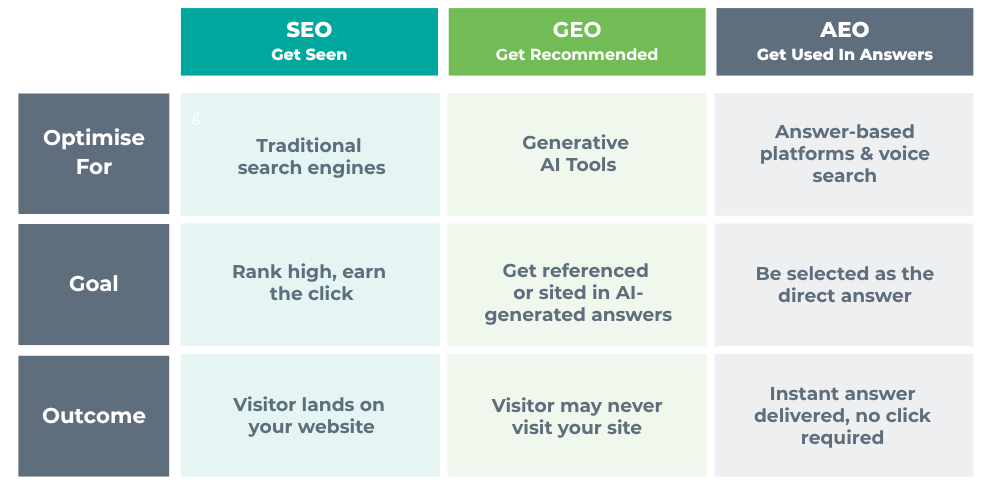
Do You Need to Choose One?
No, and please don't. These three aren't competing strategies, they're overlapping layers of the same discoverability puzzle. In fact, AI search tools still lean heavily on traditional SEO signals to decide who's trustworthy enough to reference in the first place, so ditching SEO in favour of chasing AI visibility would be a bit like trying to skip the foundations and go straight to the roof.
Think of it this way:
- SEO builds your baseline visibility and authority
- AEO gets you surfaced as the instant answer
- GEO earns you a seat at the table as a source AI tools trust enough to cite
The businesses winning right now are the ones treating their website content as something that needs to work for humans, traditional search engines, and AI systems, all at once.
The good news is that a lot of the groundwork is shared. Clear, well-organised, genuinely helpful content that answers real traveller questions will always perform well, regardless of which acronym is currently trending. Structured data, accurate business information, and consistency across the web (your hours, your offerings, your locations) matter more than ever, because AI tools are drawing on all of it to decide whether you're worth mentioning.
The Big Takeaway
SEO isn't going anywhere, but it's no longer the only game in town. As more travellers start their planning journey inside AI tools rather than a traditional search bar, tourism businesses that show up clearly, accurately, and helpfully across SEO, AEO, and GEO will be the ones getting found (and booked) first.
If you're not sure where your business currently stands in AI search results, or you'd like a hand making sense of your next steps, that's exactly the kind of thing we love talking about. Get in touch, we're always happy to chat.
Listen to Sound Advice About SEO, GEO and AEO
ABOUT THE AUTHOR
Gina Paladini | Marketing Director
Read more articles
Marketing Mythbuster #8: You need to be on every social media platform
By Tomahawk |
At the beginning of 2026, this seemed like a pretty straightforward myth to bust - "You don't need to be on every social media platform."
Trying to maintain a presence on Instagram, Facebook, Instagram, TikTok, YouTube,...
Tomahawk Launches Sound Advice for Tourism
By Tomahawk |
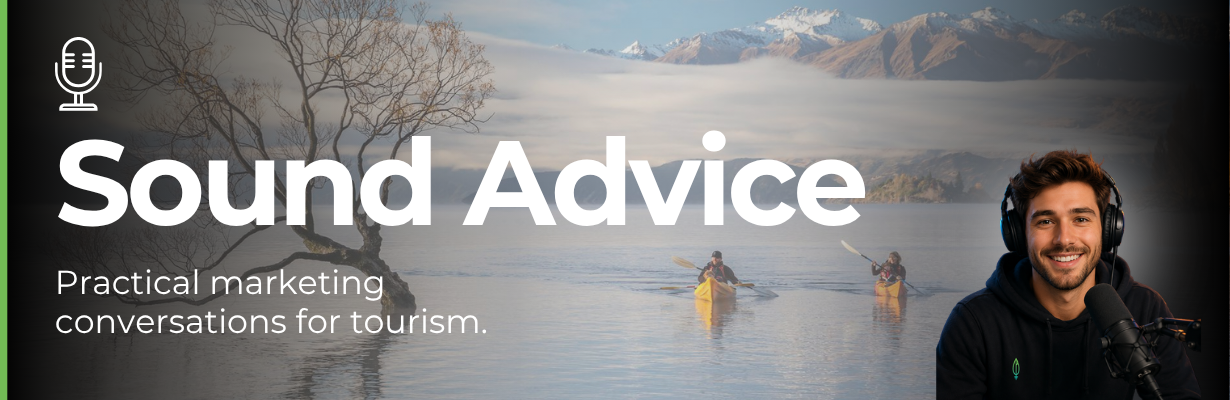
We have officially welcomed our newest team member, Chip, an AI-generated T-Hawk with a smooth voice and endless enthusiasm for tourism and digital marketing. Well...technically he isn't that new. Chip was assembled somewhere in...
